Our perspective
Physical health and the health of the territory are one and the same process. Learning to Belong.
An ecology of humankind
We believe that the body is the first landscape. That attention is a form of care. That territory is truly known by walking through it, not by visiting it. That science and contemplation are not at odds with one another: they are interdependent.
Holística Nature is a school of human ecology. Under this name, three sister schools coexist — Holistic EcoYoga, Umanagea and Geólatra. Three distinct paths that are all based on a single premise: the separation between human beings and nature is a recent concept, and it can be unlearned.
Three branches, one root
Our approach brings together three dimensions that we usually teach separately but which are, in fact, inseparable.
Natural science. A thorough understanding of the environment: geology, ethnobotany, ecology, and the cycles of the territory. Not as academic theory, but as a way of interpreting a place with discernment.
Physical practice. The body understood as a landscape: breathing, the nervous system, biomechanics, regulation. What somatic practices and yoga have been exploring for centuries.
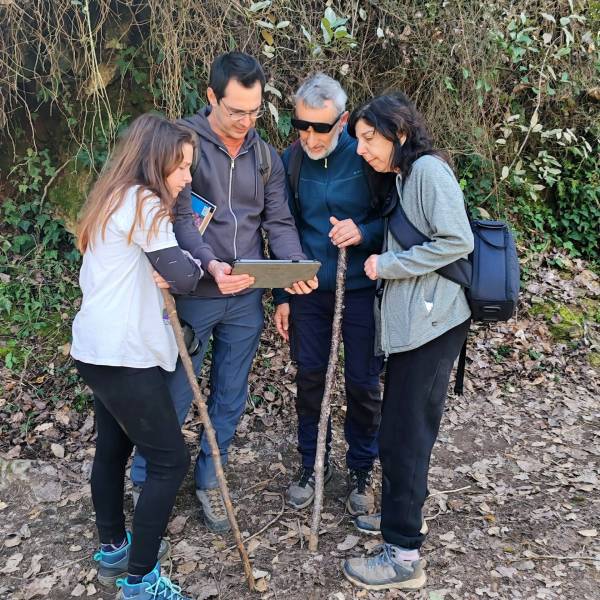
A natural experience. Where knowledge becomes experience. Applied science in direct contact with the environment, combined with another equally essential layer: perception, creativity and symbolism. The sensory dimension of learning, which transforms information into knowledge.
Together, these three elements make up what we call human ecology: a way of understanding that the inner and the outer are one and the same living system.
Three schools, one worldview
Each school focuses on a different aspect of the same principle. And each is underpinned by its own pillars, which give it structure.
Holistic EcoYoga It focuses on the body as the primary landscape. It is underpinned by four pillars: body, energy, consciousness and ecology. Physical practice understood not as an isolated exercise, but as a way of inhabiting the body within the environment that sustains it. The most intimate expression of human ecology.
Umanagea It focuses on the therapeutic relationship with nature, in whatever form it takes — pastureland, woodland, coastline, desert, riverbank. Its four pillars are body, presence, creativity and symbolism. To relearn how to be in a place, wherever that place may be, and to let the surroundings bring to life what the everyday clamour drowns out.
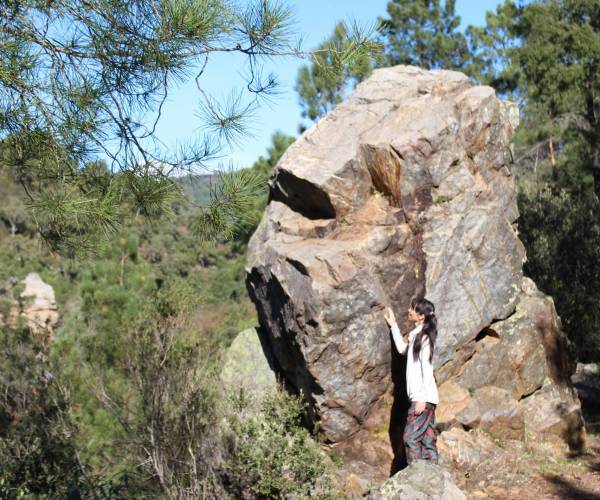
Geólatra Looks at the earth that sustains everything else. Geology, ethnobotany, reading the landscape. The Sierra de Aracena as a living classroom and, beyond that, any territory that lends itself to being interpreted. The earth as our teacher.
These are not three separate proposals. They are three approaches to the same question: how to learn to belong.

Why it matters
Twenty years of work have led us to a simple conviction. Caring for the body without understanding the place in which it lives is an incomplete practice. Studying the territory without inhabiting it amounts to information, not knowledge. And viewing nature from the outside — as spectators, as visitors, as consumers of experiences — is precisely the opposite of what we need to learn.
Human ecology is not a poetic metaphor. It is the most concrete observation possible: we are a living system within a living system. What the body knows, the landscape knows. What the earth teaches, our breath remembers.
Learning to Belong.